Given the same data, which classification model does best at labeling a tumor as malignant or benign, and how do you judge "best" when a false negative costs far more than a false positive?
Approach
Prepare the data. Standardized features from the Breast Cancer Wisconsin dataset and split it into training and test sets.
Train ten models. Logistic regression, k-nearest neighbors, support vector machine, decision tree, random forest, gradient boosting, naive Bayes, a neural network (MLP), AdaBoost and XGBoost.
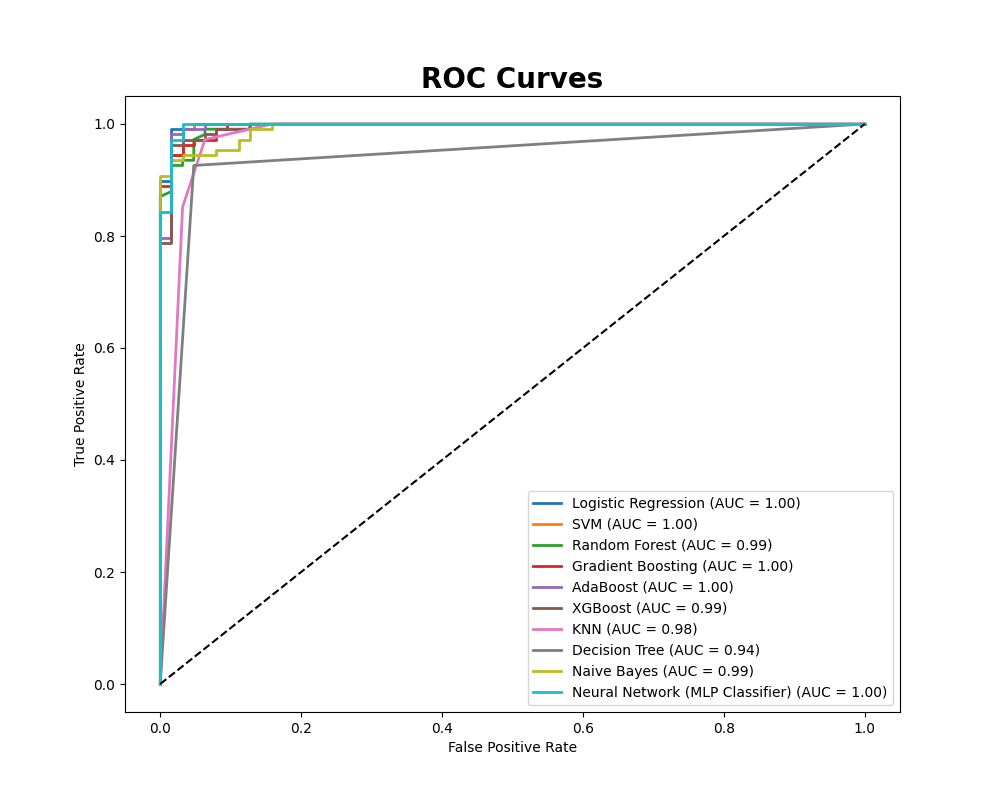
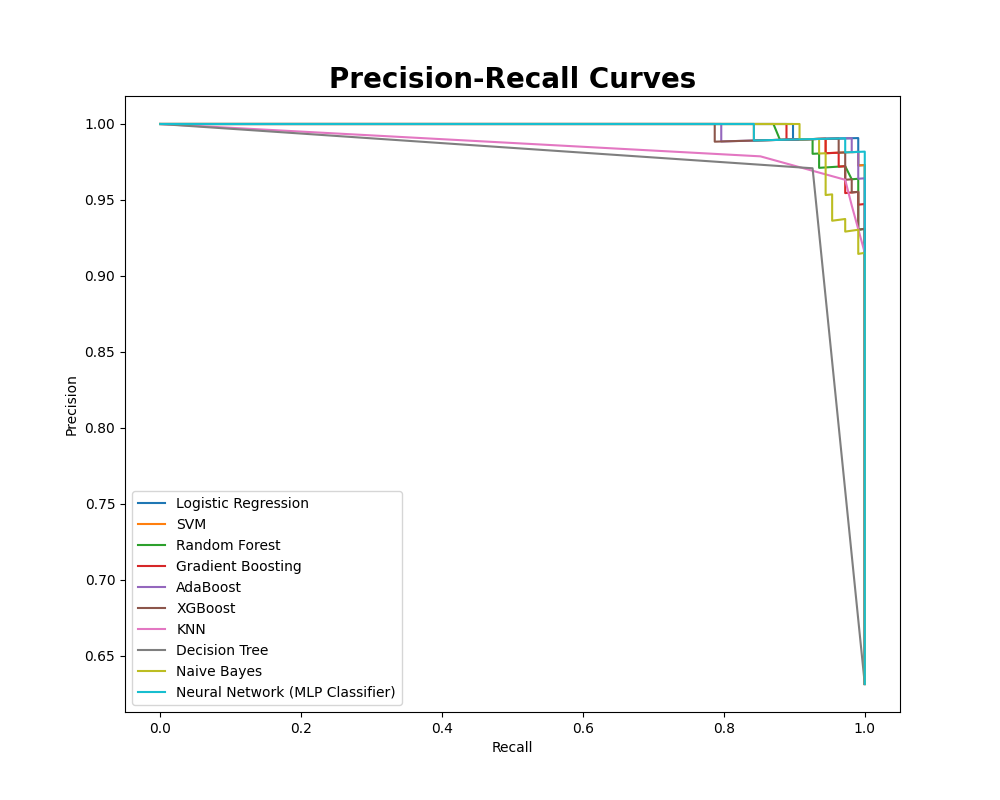
Compare them fairly. Scored each model with confusion matrices, precision, recall, F1 and ROC-AUC, and plotted ROC and precision-recall curves.
Result98%
accuracy for logistic regression, the simplest model tested.
ROC curves. Most models scored an AUC of 0.99 to 1.00; the decision tree was lowest at 0.94.Precision-recall curves for the same ten models.
Model comparisonPrecision & recallROC-AUCVisualization